The Two-Decade Head Start: Why a Tallinn Mortgage Takes Minutes and Yours Takes Weeks
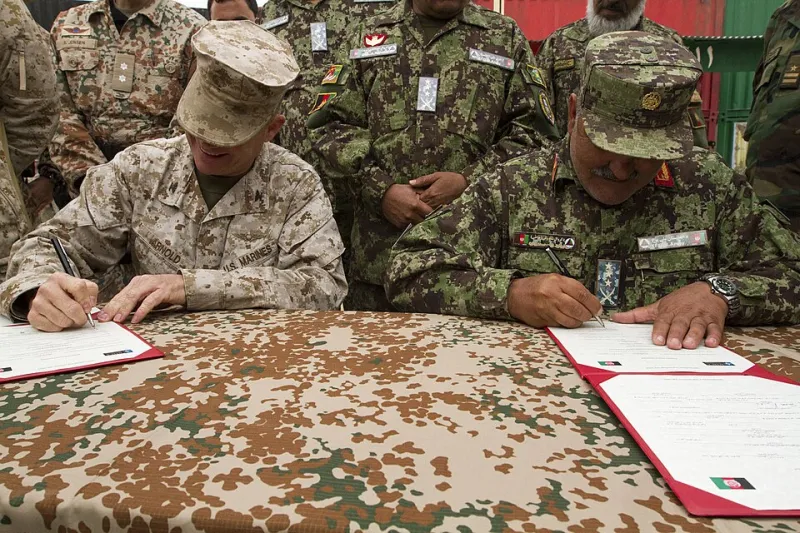
Photo: U.S. Army photo by Bill Putnam, RSC-SW/NTM-A PAO, Public domain, via Wikimedia Commons
If you have ever bought a house in the United States, you know the choreography: find a notary, drive to the notary, hope the notary is open, sign forty pages with a pen that has been handled by strangers, and then wait for a county clerk to record something so the whole thing actually counts.
In Estonia, people sign mortgage documents, employment contracts, and articles of incorporation from a laptop in a kitchen. Not as a novelty. As the ordinary, legally binding default, since roughly the time America was still arguing about whether an email counted as writing.
The law arrived before the app
Estonia passed its Digital Signatures Act in 2000, giving qualified electronic signatures the same legal weight as ink. The national ID card, which carries a chip and two certificates, became the standard identity document in 2002. The rest of the stack — signing software, timestamping, the e-notary, the land register, the business register — grew on top of that legal foundation rather than racing ahead of it.
This ordering is the entire lesson. Most countries built the technology first and then spent a decade litigating what it meant. Estonia wrote the rule that a digital signature is a signature, then let the market figure out the interfaces.
The US did something similar at the federal level — the ESIGN Act in 2000 and the Uniform Electronic Transactions Act before it — but those laws mostly say that an electronic signature can't be denied effect just because it's electronic. They don't create a single trusted identity. They leave the hard part to the states.
Mobile-ID, or: the login that isn't a password
By 2007, Estonia had mobile-ID — a SIM-based identity that lets you sign with a PIN. Smart-ID followed for people who didn't want a special SIM. The point isn't the gadget. The point is that one identity, issued by the state, works across the tax office, the hospital, the bank, the notary, and the business register, with the same legal meaning every time.
American founders will recognize the missing piece immediately: there is no equivalent national identity credential for digital signing, so every counterparty invents its own trust ritual. DocuSign and its competitors are genuinely good products, and they solved the easy 80% of contracts. What they can't do is make a county recorder in Ohio accept a signature executed on a phone in Lisbon without a parallel, state-specific process.
Why Ohio is not Estonia (and why that's a policy choice)
Notarization in the US is a state power. Remote online notarization — RON — has spread considerably: most states now authorize it in some form, and a uniform law has been adopted in a large share of them. The recording offices, title insurers, and lenders have built standards for audio-video sessions, identity proofing, and journal retention.
So the technology exists. And yet the experience is still wildly inconsistent. Some states recognize out-of-state RON sessions cleanly. Others have recording requirements that clash with the neighboring state's. Title insurers, who carry the risk, layer on their own rules. A founder in California signing with an investor in New York and a bank in Delaware can end up producing notarized documents three different ways in the same week.
That is not a cryptography problem. It's a recognition problem. And recognition problems get solved by statutes and compacts, not by better key management.
Estonia's e-notary, and the boring brilliance of it
Estonia does have notaries. They just don't require your physical presence in a room with a stamp. The e-notary system lets a notary perform their function — verifying identity, confirming intent, certifying — over the same digital infrastructure everything else runs on, with an audit trail that's stronger than a paper journal sitting in a drawer.
Consider what that means for a founder. Incorporating a company, changing its articles, pledging shares, signing a shareholder resolution: all of it happens asynchronously, with timestamps, with a record of exactly who signed what and when. If there is ever a dispute, the evidence is cleaner than a stack of wet-ink pages that could have been signed by anyone with a pen and a grudge.
Americans who have tried to close a cross-border deal know the absurdity of the reverse situation: a counterparty in Europe asks for a qualified electronic signature, and the US side offers a scanned PDF with a typed name.
What builders should actually build
The temptation in US legal tech is to build a better signing experience. That market is crowded and mostly solved. The unsolved part is downstream: the recorder, the insurer, the counterparty's counsel, the auditor. Every one of those is a gatekeeper who needs a reason to say yes, and the reasons are procedural, not technical.
So build for the gatekeeper. Build the evidence packet that a title underwriter will accept without a phone call. Build the identity proofing that a state regulator recognizes. Build the audit export that a court will admit without an expert witness. The Estonian lesson is that trust artifacts, done properly, are the product.
What the rest of us should push for
If you're a remote worker, a founder, or someone buying a house in a state where the RON rules are still ambiguous, the useful move isn't to wait for a national standard. It's to push for reciprocal recognition between states — a compact, not a mandate — and to fund the county clerks who are the actual bottleneck. A clerk with a modern recording system is worth more to the digital economy than a dozen new signature apps.
Estonia got here by deciding in 2000 that a signature is a signature, wherever it happens. Twenty-six years later, the technology has caught up everywhere. The law, in most of America, is still in the car on the way to the notary.